
Joe Newman, The Rudy Schwartz Project
For my money, Joe Newman is one of the greatest home tapers ever and his run of Rudy Schwartz Project tapes are among the best ever done by ANY home recordist. Not only are they laugh out loud funny but they are finely honed art works of scatological and sociological irreverence. There were also tapes called: Yodelin Satan, Don’t Get Charred Get Puffy, and Enhanced Florence Henderson. Some of his early material has been re-issued and there have been CD issues of some tapes as well.
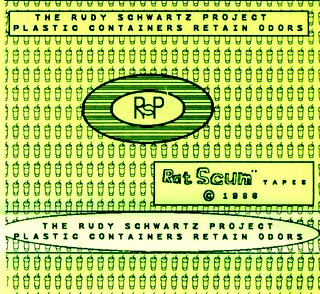
Early on Joe called his label Rat Scum Tapes. You can tell just from his titles that he was in different territory than most. Above, the 1986 tape, Plastic Containers Retain Odors.
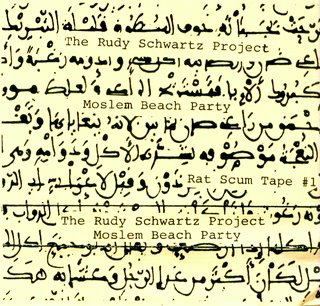
Above, the 1985 release, Moslem Beach Party.
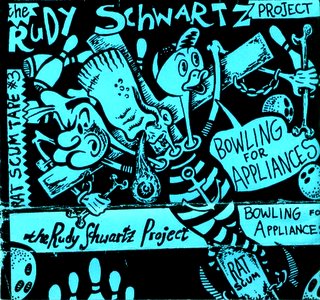
Above, 1988’s Bowling For Appliances. The first track is called “Lynyrd Skynrd Memorial Tractor Pull”. On side two a track named “Nice Lawn, Asshole” which also appeared on USA Goes Pop (Check out track ten ), a compilation I posted.
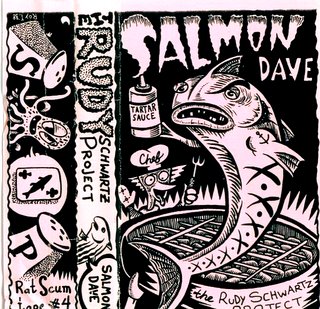
The excellent art work for many of these tapes was done by Roy Tompkins, an artist from Austin at that time. He’s still at it.
Why did you call it The Rudy Schwartz Project?
I was always annoyed when somebody named their band a “project,” like Alan Parsons Project, Joe Perry Project, etc. So I thought of a dorky name and stuck “project” after it. Had I known I would be doing it for as long as I did, I probably would have thought about it longer.
What years did this run? Was all the recording done in Texas?
Mainly from 1984 to 1995, and mainly in Texas. I wrote a song on the ukulele a few years ago, and we rented a Portland studio to record it. But mostly Austin.
Your Zappa influence is often mentioned. How do you feel about it? And what do you see as his biggest influence on you? Musically? Social anthropologically? What was your first exposure to The Mothers?
The Zappa influence is obvious, and it doesn’t bother me when people point out the obvious. His influence rubbed off on me both musically and politically. The Dead Kennedys also influenced me politically, but no so much musically. My first exposure to The Mothers was in my college dormitory, where I was fortunate enough to be surrounded by an assortment of delightfully strange people who contrasted well with my rural Missouri upbringing.
Your song, “Frank”, on the compilation ( compiled by Russ Stedman) , “Where’s My Waitress” is actually a very touching and heartfelt tribute and one of the only originals on that release. I love that song. What do you think when you hear that…or other old tunes. How do they hold up for you?
I think my later stuff holds up better than my early stuff, but people
have told me they disagree with that. I split it into two phases,
marked by the quality of equipment I had to work with, and the
second phase came closer to what I had in mind than the first phase.
Some of my music from both phases makes me cringe now. Some
of it still makes me smile. I think “Frank” is pretty good, for what it is.
I basically looked at the melodic intervals he used for “Uncle Meat” and “Dog Breath,” then slapped together a new melody and used pretty much the same march tempo as “Uncle Meat.” Someone once accused me of stealing samples from Zappa music to construct it, but that was way off in the weeds.
Did you like do-wop yourself? What other groups or music did you like or feel inspired by?
I love doo-wop vocal music. Many people trace the deterioration
of civilization to the Reagan administration, but I think it actually began much sooner when somebody decided that The Beatles were an improvement over Clyde McPhatter and the Drifters. That person belongs in hell in the same room as the guy who ratted on Anne Frank’s family. To answer your second question, in the period when I was writing music, I was listening to Captain Beefheart, punk rock, Eric Dolphy, lots of other jazz, The Reverend Fred Lane, Euro prog rock stuff like Faust and Can, and anything else that amused me. Nowadays I’ve gravitated toward quieter stuff, and I steer toward bop and pre-bop jazz, old ethnic music of various stripes from the 78 rpm era, and some ambient drone stuff like Stars of the Lid or Loscil. I’ve also been getting into some Quebecois music lately. Check out Soldat Lebrun sometime if you like old hillbilly music, or
Les Classels if you want to see what happens when everyone in
a rock group dresses like Heino.
Did you start playing an instrument early in life? Were there early bands?
My first instrument was probably a plastic flutophone in Catholic school. One time we held a big flutophone concert and everyone’s parents were subjected to an auditorium of eight year olds playing “Clementine” on flutophones. I would kill for a tape of that atrocity. I think I got my first guitar in fourth grade. I really dug Hank Williams. I wasn’t in any bands until I moved to Austin after college.
You had some guest musicians on many of your tapes. And your arrangements could be pretty complex. Did you give them charts or closely instruct them? Did you consider your self a “perfectionist”?
Sometimes I wrote it out and sometimes they winged it. It depended
on the situation. The sax/clarinet arrangement on “Kill For God” was
written out, because the guy knew how to read. I also wrote out
“Moammar’s Tractor” for the bagpipe player on “Salmon Dave.” But
if someone came over to play an improvised solo, I’d usually just hit the record button.
Did you ever consider getting a live band to play Rudy material?
Yes, around 1990 or so, some asshole in Los Angeles offered to fly a band to the coast to play a gig with some other bands that he had supposedly booked. I think he was claiming to have lined up fIREHOSE and Chumbawama as well. Me being a dumbass, I put a band together, spent a lot of time and money rehearsing, then got screwed by this prick, who suddenly quit returning mail and phone calls. Unfortunately, the internet and email weren’t as prevalent then, or else it would have been much easier to hurl profanity at him. We played one gig in Austin and that was it.
Your tapes sort of felt like concept albums to me although that might be stretching it. Did you have themes you wanted to develop on certain releases?
No, not really, other than the bile floating around in my brain in those days. I suppose “Yodelin’ Satan” had a movie soundtrack theme going on, but it wasn’t fleshed out enough to fill out the whole cassette.
Some of your music was released on a German ( I believe) label. How did that come about?
I’m embarrassed to admit that I don’t even remember. They put out an LP and a CD and they were very fair to me, but I don’t recollect very much about our business arrangement.
Your attacks on society and religion in particular were vicious…and hilarious. Was there ever any backlash from people who heard your music and reacted negatively?
Very little. I received a few creepy letters from outraged religious
fanatics. The most memorable was scribbled on this creepy stationery
with kittens on it, challenging me to a debate by mail. The guy had bought everything I sold, then burned it in some sort of ritual instead
of asking for a refund. I didn’t accept his challenge.
Do you have any spiritual leanings now? Maybe a closet Mormon?
No. I think “spiritual leanings” are one of the worst poisons circulating
among the human race, right up there with greed, hatred, and Fox News.
Have you gone back and re-released all of the tapes?
No, because much of it doesn’t deserve it. We’re planning a CD release containing the better material from my first two cassettes. It’ll be on DC-Jam Records and it will be called “Remembering a Summertime Rash.”
What was your first experience trading tapes with another home taper? Did you have any favorite home tapers at that time?
I think Dino DiMuro was the first I traded with. But I hate picking favorites, because then I’d forget somebody and feel like an asshole. But I will say that I received a lot of tapes in the mail and many of them made me happy in one way or another.
What was the best part of recording this music?
That’s hard to answer. The best part was when something worked better than I had anticipated. That didn’t happen very often, but one song that I especially enjoyed working on was “Barbecue Bud’s.” I think that one just fell together beautifully.
When did the urge to stop recording as The Rudy Schwartz Project happen? Were you burned out? Tired of ambivalence? Do you ever miss it?
It wasn’t really an urge, so much as running out of things to say, and having life get more complicated such that I didn’t have as much free time. Yes, I do miss it sometimes.
To me, cassette culture was as much as social phenomenon as a musical one. What do you think?
Yeah, I’d agree with that. It was also the seed for eliminating the need for record companies, so long as you don’t care about making a lot of money. If I may extend this tedious metaphor, the Internet has been the fertilizer.
Do you think there is any lasting legacy of the underground tape movement?
Maybe it made it easier for more people to produce and distribute music, at least on a small scale. Of course, that can be a double edged sword, because there are many people who probably shouldn’t be distributing music. But that’s just as true for major labels.
What are the current projects you would like people to know about? The best URL?
Just the upcoming CD release on DC-Jam. We’ve also got “Salmon Dave” available with MP3 downloads. Not much else going on here. The best place to contact me would be at: MySpace
You recently emigrated to Canada. Why? Has it been a good move so far?
After Bush was reelected, my wife and I decided to leave. I don’t want to pay taxes to a country that’s going to seriously debate whether it’s okay to torture people, or let the government monitor their email without a warrant. It’s not easy to immigrate to Canada, because it takes a lot of time and money. While we were going through the process, the Katrina thing happened, and I was watching a crowd of people on television, surrounded by a moat of shit with no drinking water. Meanwhile, the fuckwits in the Bush administration were busy making excuses and shifting blame. If I had any remaining doubts about leaving, that pretty much washed them away. We’re glad to be in Canada, and we love Montreal. It’s not utopia, but the overall mental health of Canadians is a few notches above America. And despite all of the lies you’re frequently fed, the health care system up here actually works pretty well. But yes, it does get cold as fuck in January and February.
Thanks Joe, good luck with everything.
Thanks for putting together this groovy website, Don

